
The Evolution of Wall Chess: From Historic Demonstration Boards to Modern ChessboArt Designs
Meta-Beschreibung für Shopify: Explore the fascinating history of demonstration and vertical chess boards. Discover how these wall-mounted chess sets evolved from traditional match displays to the innovative, functional, and decorative designs by ChessboArt. Perfect for schools, clubs, and elegant interiors.
For centuries, **wall-mounted chess sets** – often called demonstration boards or vertical chess sets – have served a crucial purpose: allowing audiences to follow a chess game in progress. They eliminated the need for spectators to crowd around the players, which could easily lead to distraction during high-stakes matches. Instead, a large, upright chessboard would be positioned in a prominent area, with an assistant relaying moves from the players’ private board onto the display. This ingenious method allowed many viewers to simultaneously observe the unfolding strategic battle.
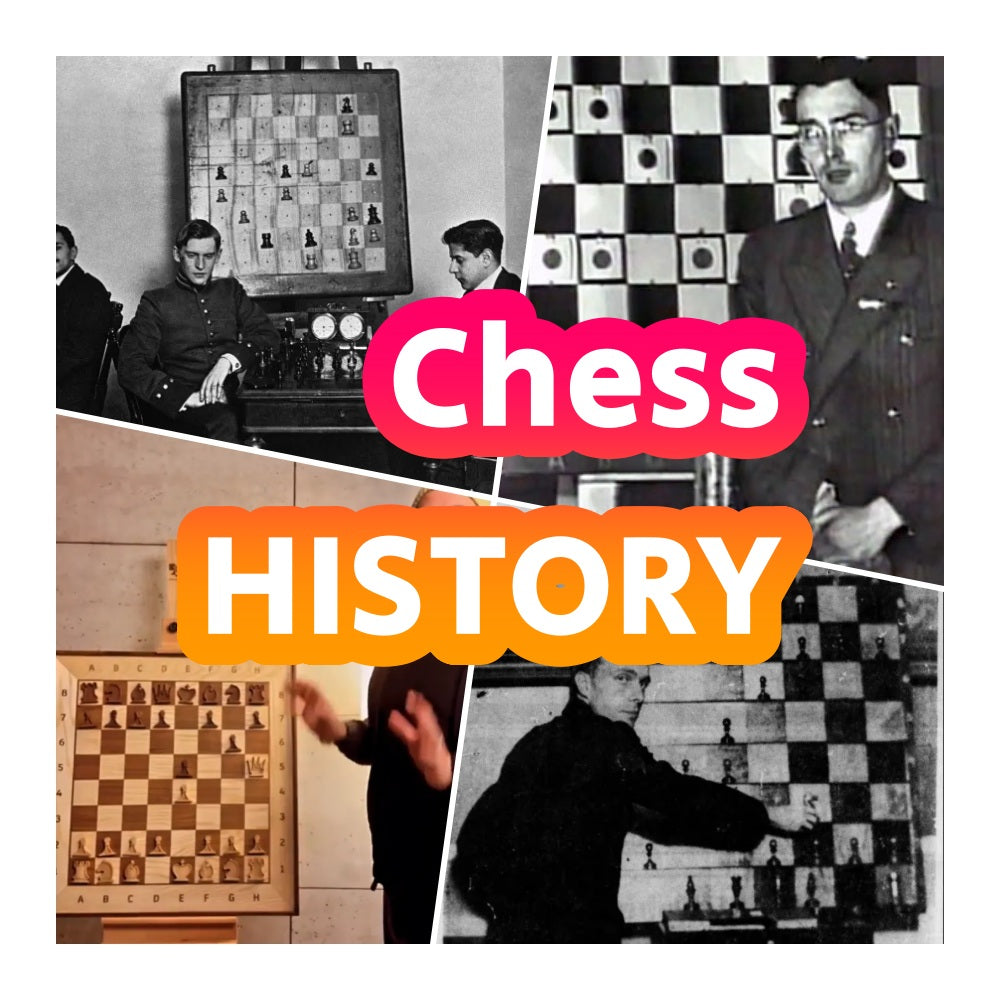
The earliest photographs of **demonstration chess boards** we’ve managed to uncover date back as far as 1913, showcasing a remarkable variety of designs and uses throughout history.


These four historical photos, with the oldest dating back over a century, reveal a fascinating evolution in how chess pieces were attached to a vertical board. It's remarkable to see the diverse concepts employed to display the game to an audience.
Historical Concepts of Wall-Mounted Chess Displays
1. Peg-in-Hole Chess Boards: Precision and Stability
In the oldest photograph, the board features holes, and the chess pieces are designed with corresponding pegs. While the pieces are three-dimensional and resemble traditional sets cut in half, the proportion of the chess squares is maintained. These were likely custom-made sets, providing excellent stability for clear viewing by spectators.
2. Hanging Chess Pieces: The Unique Aesthetic of the Roaring Twenties
Photos from the 1920s and 30s showcase a truly unique design where figures and pawns are hung on hangers, much like ornaments on a Christmas tree. These **hanging chess sets** were undoubtedly specifically designed for public display. While the convenience of moving pieces might not have been paramount with this solution, the primary goal of visually demonstrating the game was successfully achieved.
3. Shelf Chessboards: Simplicity Meets Practicality
The solution seen in the 1930s photo represents perhaps the simplest concept. Here, the chessboard serves as a flat background with square fields, and the pieces are placed on small shelves. This was undoubtedly a straightforward and aesthetic approach, allowing for relatively easy movement of pieces. A minor drawback might have been the viewing perspective of the chess position. The pieces themselves were likely specially designed to ensure a consistent appearance, avoiding the need for rectangular board fields.
Contemporary Demonstration and Vertical Chess Sets: What's Available Now?
Today, the demands and possibilities for **display chess boards** have changed significantly. Stores primarily offer two main versions:
- **Training Demonstration Chess:** These are usually portable, often used by teachers in schools and chess clubs. They feature a metal board with flat, magnetic pieces. They are practical, lightweight, and easy to transport for educational purposes.
- **Decorative Vertical Chess:** In this style, traditional chess pieces are placed on shelves that form a chessboard. Most designs feature rectangular fields, rather than true squares, and the entire board is often elongated. While they serve an **ornamental and decorative purpose** beautifully, their practical application for teaching or even casual problem-solving can be quite challenging due to the non-standard proportions.
For a comprehensive look at modern wall-mounted chess solutions, explore our collection of hanging chess sets.
Demonstration Chess by ChessboArt: Blending Professionalism and Premium Design
At ChessboArt, we set out to create something different: a truly professional **wall chess set** designed for both serious play and effective training. We engineered our chess pieces from scratch, drawing inspiration from universally recognized chess diagrams. This diagrammatic representation of pieces and boards is familiar to every player from books, newspapers, and, more recently, from dominant online chess platforms. A diagrammatic wall chess set from ChessboArt can be comfortably used for learning, analyzing, and demonstrating games.

The Aesthetic Appeal of ChessboArt: Wood Craftsmanship and Precise Magnetism
Ein zweites, grundlegendes Prinzip hinter unseren Schachsets war ihre ästhetische Anziehungskraft. Unsere **ChessboArt Wand-Schachbretter** sind aus hellem und dunklem Holz gefertigt. Wir sind überzeugt, dass Holz das perfekte und historisch gerechtfertigte Material für die Herstellung von Schachsets ist. Darüber hinaus integrieren sich Holzschachbretter nahtlos in jedes Interieur und verleihen Charakter und Raffinesse. Genau aus diesem Grund wurden unsere **Premium-Wand-Schachsets** mit besonderer Sorgfalt hinsichtlich Material und Verarbeitung entworfen.
Bei ChessboArt-Schach müssen die Figuren absolut gerade stehen! Jede Figur verfügt über zwei interne Magnete, ebenso wie jedes Feld auf dem Brett. Dieses Zwei-Magnet-System sorgt für eine einfache und präzise Ausrichtung und verhindert, dass Figuren sich um einen einzelnen Magneten drehen. Dieses sorgfältige Design gewährleistet, dass vertikale und horizontale Linien sowie Symmetrieachsen eingehalten werden – entscheidend für eine klare und genaue Darstellung der Schachstellung.
Wo werden wandmontierte Schachsets heute verwendet?
Über die offensichtlichen Einsatzbereiche in Schulen (Bildung), Zuhause (Lernen und Dekor) und Unternehmen (Markenimage und Entspannungszonen) hinaus, tauchen **wandmontierte Schachsets** zunehmend in öffentlichen Räumen und Medien auf. Sie dienen als hervorragendes Medium für Markenpräsenz, und nach Jahren begrenzter Aufmerksamkeit in der Presse wird ihr Wert wieder erkannt.

